Over the past few months, I’ve had the opportunity to connect with several Wolfeboro and Lakes Region organizations that are looking for help with their websites.
Recently, I’ve been contacted by the Lakes Region Repeaters Association (LRRA), the Wolfeboro Lions Club, and Morrissey’s Front Porch. I’ve also continued a conversation with First Christian Church of Wolfeboro. I’ve submitted landing-page prototypes and proposals to all except Morrissey’s, and I’ve had the chance to meet some of the people involved with LRRA and the Lions Club in person.
That last part has been particularly rewarding.
As a local Wolfeboro website designer, I’m finding that some of the most valuable parts of the work happen away from the computer.
Getting to Know the People Behind the Websites
I attended one of LRRA’s monthly Sunday breakfasts at the Masonic Lodge in Wolfeboro. It was enlightening to spend some time getting to know these ham-radio enthusiasts—many of whom have engineering backgrounds—and to hear their perspectives while sharing some of my own ideas about their website.
I also met with members of the Wolfeboro Lions Club at the Wolfeboro Public Library. We talked about some of the frustrations they’re experiencing with their current website and what they’d like to accomplish going forward.
Both the LRRA and Lions Club proposals and prototypes have been received favorably. They each have meetings scheduled within the next couple of months to discuss their plans, so I won’t know for a while whether either project will move forward.
WordPress, Wix and Finding the Right Fit
Each of these projects has also given me an opportunity to dig into a different technology.
LRRA’s site is built with WordPress, while the Lions Club site is built with Wix. Both platforms have their strengths, and both can be good choices when they’re configured and managed appropriately.
That’s an important part of my approach to website strategy. I don’t think every organization needs the same platform, the same features, or the same type of website. The technology should support the organization—not the other way around.
Morrissey’s Front Porch presents a somewhat different situation. Based on my email conversations with them, WordPress looks like it could be a good fit, particularly because they want the ability to update their lunch and dinner menus as needed without having to call a web developer every time.
I actually took my mom to Morrissey’s recently for a scoop of frozen yogurt. I didn’t attempt to track down the owner or turn the visit into a sales call. If he’s still interested in improving the website, I may stop by sometime when I’m in the area and see if he’s around.
But I’m in no hurry to push it.
Website Strategy Starts With Listening
One thing these recent conversations have reinforced for me is that website design should start with strategy.
Before worrying about colors, fonts, animations, or which WordPress theme to use, it’s worth asking some basic questions:
- Who is the website actually serving?
- What do visitors need to find?
- What does the organization want visitors to do?
- Who will maintain the site after it launches?
- What technology makes sense for the people who will actually use it?
Those questions can lead to very different answers for a restaurant, a service business, a community organization, a church, or a volunteer club.
That’s why I’ve increasingly been describing what I do as Website Strategy & UX/UI Design, rather than simply website development.
The technology matters. But understanding the problem comes first.
Making Web Design a Little More Personal
There’s something I’m increasingly appreciating about working with local organizations.
A website project can begin with an email, a contact form, or a phone call. Most of the work can happen through screens and software. But ultimately, there are people on both sides of that screen.
We’re all part of the same Wolfeboro and Lakes Region communities.
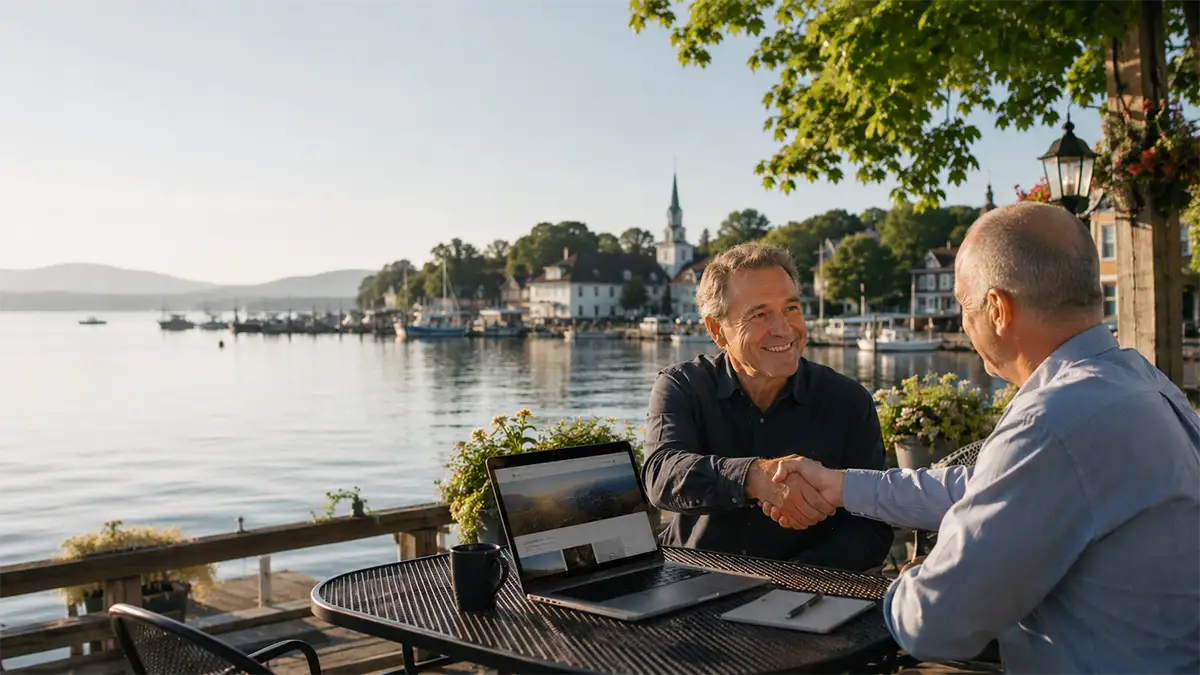
That’s one reason I’m glad to meet clients—and prospective clients—in person when the opportunity arises. I think a willingness to sit down, shake hands, listen, and talk through a problem can break down some of the barriers that come with entrusting your website to someone you may otherwise know only as a name in an email.
This is especially true for small businesses, clubs, churches, nonprofits, and community organizations. These aren’t faceless corporations with an anonymous web department. They’re people trying to make their organizations work better.
And they need someone who understands both sides of the equation: what the technology can do and what the people actually need.
Lakes Region Web Design With a Local Connection
That’s increasingly how I see my role in Lakes Region web design.
I still like being the Website Handyman—the person who can fix the broken thing, figure out why something isn’t working, or make a needed change without turning it into a major project.
But I’m also expanding that role into Website Strategy & UX/UI Design: helping local Wolfeboro and Lakes Region businesses and organizations figure out what their website should be doing in the first place, how it should work for their visitors, and how they can manage their online presence without the frustration.
In a way, I’m trying to bridge two worlds.
I appreciate the old-school approach of a personal introduction, a conversation across a table, and a handshake. At the same time, I genuinely enjoy modern technology and the constantly changing web-development landscape.
I don’t think those things are incompatible.
Maybe the best approach to modern technology is sometimes a little old-fashioned: meet the people, listen to what they need, and then figure out the technology that gets them there.
That’s the kind of Wolfeboro website design and Lakes Region web design I strive for—local, practical, personal, and grounded in good website strategy.